
The short version. AEO vs SEO is mostly a difference in where you look, not in what you do. AEO (answer engine optimization) and GEO (generative engine optimization) are two names for one aim: being a source that an AI answer draws on. Google says that, for its search, optimizing for AI features “is optimizing for the search experience, and thus still SEO,” and Search Console counts AI Overview and AI Mode impressions inside web search. On my own site that slice was 43 of 637 impressions in 38 days, and it went mostly to the pages that already drew the most web impressions, plus a cookie policy with no FAQ and no answer box. Two things really are different: ChatGPT, Claude and Perplexity send crawlers of their own, and the reports count AI impressions and citations, not rankings.
If you search for the difference between AEO, SEO and GEO, the first page of Google is made of guides, most of them written by agencies. The three at the top for “aeo vs seo” on November 5, 2026 agree on the shape of the answer: SEO earns rankings and clicks, AEO earns direct answers and citations, and AEO needs tactics of its own. Their lists overlap: FAQ schema, a short direct answer at the top of the page (one of them puts it at 40 to 60 words), headings written as questions, and a conversational tone. None of the three shows a measurement taken on a website, with a method you could repeat.
So I checked the claim from the other side: against the documentation of the engines that write the answers, and against the data of a site I can see from the inside, this one. I exported both of Google Search Console’s reports for visibleorigin.com, web search and generative AI features, for the same 38 days. My server also keeps a log of every crawler that asks for a page, and I can verify each one by its address rather than by the name it gives. This note puts the definitions next to those numbers, and the numbers do not describe three disciplines.
AEO vs SEO vs GEO: where each name comes from
The three names did not arrive together, and only one of them has a founding document. Knowing which is which explains most of the confusion in the search results.
SEO
Google defines it in its own starter guide: “SEO—short for search engine optimization—is about helping search engines understand your content, and helping users find your site and make a decision about whether they should visit your site through a search engine.” Bing’s webmaster guidelines put it in their own words: search engine optimization “improves the technical quality, clarity, and accessibility of websites, helping Bing discover, understand, and evaluate content.” Neither definition mentions a results page. Both are about an engine understanding a page and a person finding it, which is why the same definitions keep working when the results page turns into an answer.
AEO
Answer engine optimization is older than AI chat. The earliest use I could open is a Search Engine Watch article from February 7, 2018, written when the answers in question came from featured snippets and smart speakers. The rise of voice search, it says, is “transforming search engines into ‘answer engines’,” and “This strategy has come to be known as AEO, or ‘answer engine optimization’.” The article quotes two SEO specialists from a webinar and does not say who coined the term. Kalicube, the company of one of them, says on its own site that “Jason Barnard coined ‘Answer Engine Optimization’ in 2017”; I found no independent source for that date.
What matters more than the date is what is missing. AEO has no paper and no standard behind it, and no engine treats it as a discipline of its own. Bing’s guidelines do not use the term at all, and Google mentions it as one of the “terms you may see used” and files the work under SEO, as the next section shows. It meant featured snippets and voice answers in 2018, and it means AI answers now. The name stayed; what it points at changed.
GEO
Generative engine optimization, by contrast, has a birth certificate. It was named in “GEO: Generative Engine Optimization,” a paper by Pranjal Aggarwal and five co-authors, first posted to arXiv on November 16, 2023 and accepted to KDD 2024. Its abstract says: “we introduce Generative Engine Optimization (GEO), the first novel paradigm to aid content creators in improving their content visibility in generative engine responses.” Bing has since adopted the word, and its guidelines say that “Generative Engine Optimization (GEO) focuses on content eligibility for grounding and reference in AI responses.” What the paper actually measured, and why its headline “up to 40%” does not carry over to a real site, I went through in generative engine optimization, read against the paper that named it.
The other GEO: geography
Part of the confusion in this search has nothing to do with AI. On November 5, the first Google result for “geo vs seo” was a forum thread asking what the difference is between GEO and local SEO, and the second was a page explaining that “GEO SEO” is used for two different things. In local and international SEO, “geo” means geography: showing up for searchers in a city, a region or a country. Google describes that ranking in its Business Profile help: “Local results are mainly based on relevance, distance, and popularity.” That is a separate job, with signals of its own, and nothing below is about it.
What Google and Bing say the difference is
The two engines that turn their search results into AI answers have both written down their position, and their documents are less ambiguous than the guides that rank for the question.
Google treats AEO and GEO as SEO. Its guide to generative AI features in Google Search, last updated on July 10, 2026, has a box titled “What about ‘AEO’ and ‘GEO’?” that ends: “From Google Search’s perspective, optimizing for generative AI search is optimizing for the search experience, and thus still SEO.” The reason it gives is mechanical, not a matter of style: “our generative AI features on Google Search are rooted in our core Search ranking and quality systems.” Google’s page on AI features sets the entry condition in the same spirit: “To be eligible to be shown as a supporting link in AI Overviews or AI Mode, a page must be indexed and eligible to be shown in Google Search with a snippet,” and “There are no additional requirements to appear in AI Overviews or AI Mode, nor other special optimizations necessary.”
The guide then lists what it calls “AEO/GEO hacks” and says: “For Google Search, you can ignore tactics like ‘chunking’ content, creating unnecessary AI text files (like llms.txt), or pursuing inauthentic mentions.” It also has a warning about the business that has grown around the names: “If you’re considering third-party ‘AEO’ or ‘GEO’ advice or services, review our guidance on evaluating third-party SEO advice.” That sentence applies to this site as well, since AEO is the name of the service it sells. It is also why the first line under what I will not promise is that you will appear in ChatGPT, Perplexity or AI Overviews. Nobody controls what those systems surface.
Bing keeps the word GEO, but not a separate foundation. Its webmaster guidelines define SEO and GEO side by side, and then add: “SEO does not guarantee rankings or traffic, and GEO does not guarantee grounding or citations in AI experiences.” Under a heading that says “SEO Fundamentals Still Apply to Grounding and AI Experiences,” the guidelines state: “Bing and Copilot search experiences rely on the same core crawling, indexing, and ranking foundation as traditional search.” Bing goes further than Google on what helps an AI answer pick a page: “URLs are more likely to be selected for grounding queries and citations when content stands on its own,” and “URLs focused on a primary topic are more likely to be selected for grounding results.” Neither comes with a number, and both sit in the same guidelines as the rest of Bing’s advice for search.
Read side by side, the two documents draw the line in the same place. The crawling, the index and the ranking are shared. What is new is the surface where a page can show up, and the report that counts it. That is a statement about Google and Bing only: the AI companies run engines with crawlers of their own, and I come back to them after the data.
Measured: Google counts its AI answers inside web search
Search Console has two reports that matter here. The general performance report counts impressions, clicks and positions in Google Search. The generative AI performance report, which Google says it rolled out “to all websites worldwide” as of August 31, 2026, counts one thing: “Impressions are how many times links to your site were shown to a user in a generative AI feature on Google Search,” and the features it lists are AI Overviews and AI Mode. Its help page states how the two reports relate in a single line: “The generative AI performance report includes data from the Web search type in the Performance report (Search results).” In Google’s own accounting, the AEO number is a slice of the SEO number, not a second channel next to it.
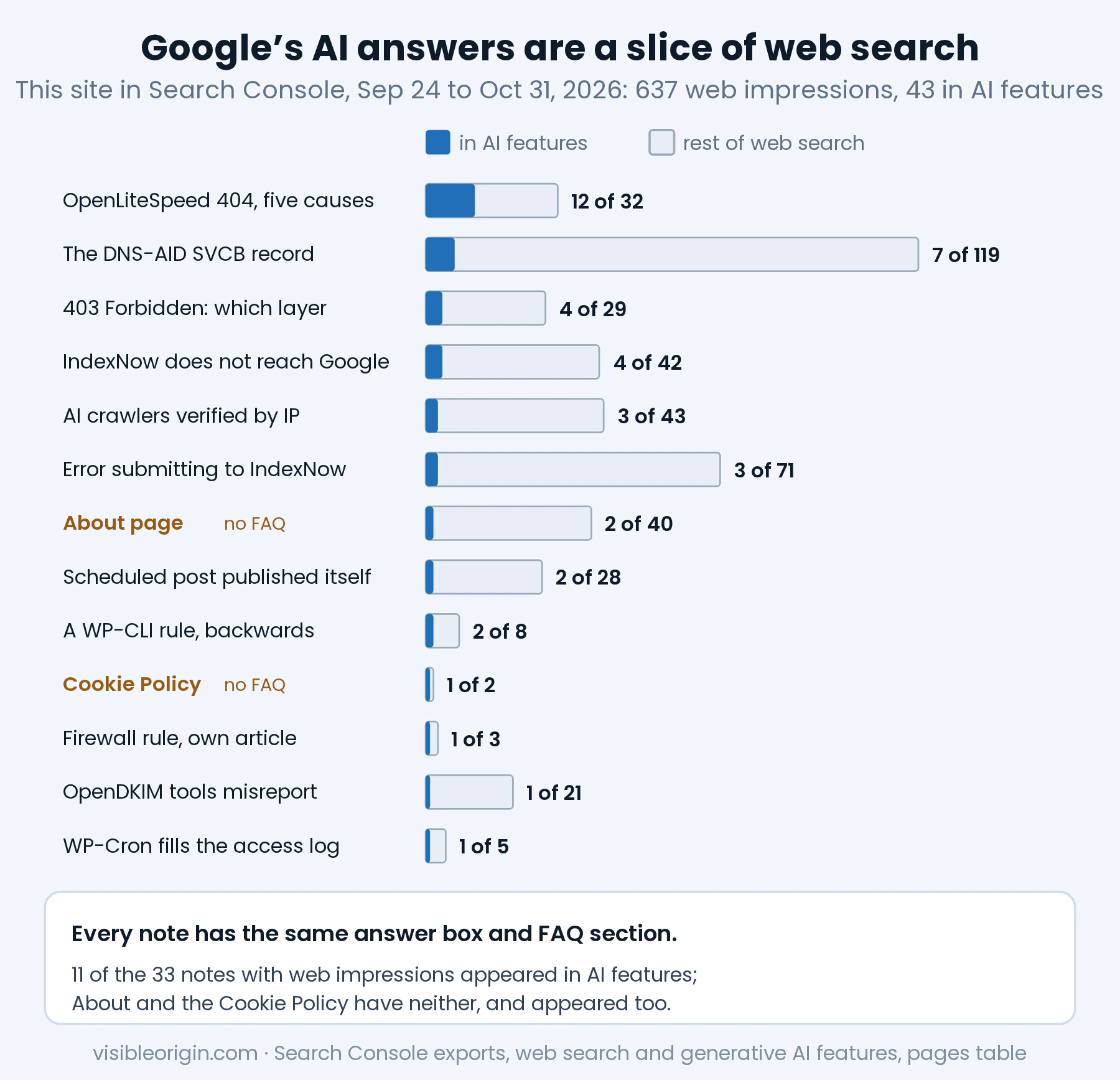
I exported both reports for visibleorigin.com on November 2. The exports cover September 24 to October 31, 2026: 38 days, all the data they contained. Web search had 637 impressions and 4 clicks. Generative AI features had 43 impressions, or 6.8% of the web total, on 18 different days between September 29 and October 30, 40 of them on desktop and 3 on mobile, spread over 13 pages. The AI export has no clicks column and no queries. A click on a link inside an AI Overview lands in the general report, where Google says “Clicking a link to an external page in the AI Overview counts as a click.” So I can say which pages appeared in AI features and how often, but not for which questions, and not whether anyone clicked from there.
| Page on this site | Web impressions | In AI features |
|---|---|---|
| OpenLiteSpeed 404, five causes | 32 | 12 |
| The DNS-AID SVCB record | 119 | 7 |
| 403 Forbidden: which layer sent it | 29 | 4 |
| IndexNow does not reach Google | 42 | 4 |
| AI crawlers verified by IP | 43 | 3 |
| Error submitting a page to IndexNow | 71 | 3 |
| About (no FAQ, no answer box) | 40 | 2 |
| A scheduled post that published itself | 28 | 2 |
| A WP-CLI rule that was backwards | 8 | 2 |
| Cookie Policy (no FAQ, no answer box) | 2 | 1 |
| A firewall rule that blocked my own article | 3 | 1 |
| OpenDKIM tools that misreport | 21 | 1 |
| WP-Cron filling the access log | 5 | 1 |
Search Console exports for visibleorigin.com, September 24 to October 31, 2026. The AI-feature impressions are included in the web column. The 45 page rows of the full web export add up to 669 impressions rather than the 637 of its chart, a kind of difference Google attributes to property versus page aggregation.
The table holds the first finding, and it is about the template more than the numbers. Every note on this site is built the same way: a short answer in a box at the top, headings, and an FAQ section that the site also publishes as FAQPage markup, which is the format the guides recommend for AEO. I checked WordPress’s stored revisions to make sure that was true for the whole period, and not just today. Of the 40 notes, 39 had the box and the FAQ in their first saved draft, and the oldest one got both on September 1, more than three weeks before the exports begin.
If that format decided which pages Google showed in its AI features, the notes would have appeared at similar rates. They did not. Of the 33 notes with web impressions, 11 appeared in AI features and 22 did not. And two of the 13 pages are not notes at all: the About page and the Cookie Policy, which have neither the answer box nor an FAQ, appeared as well. The format was a constant across every note, and a constant cannot explain a difference.
What did separate the pages was their visibility in ordinary search. Taking out the AI impressions, which Google counts inside the web ones, the pages that appeared in AI features had a median of 25 web impressions each, and the pages that did not had a median of 3. The five pages with the most web impressions outside AI features all appeared in AI features. The next two did not, and both were new: my note on robots.txt for AI crawlers, published on October 26, collected 30 web impressions in its six days, and the AI visibility checker, a tool page published on October 22, collected 27. The page with the most AI impressions, a note on five causes of OpenLiteSpeed 404 errors, was published on October 17 and got 12 of its 32 impressions in AI features.
This is one site, 38 days and 43 impressions, so it supports a narrow conclusion, and I want to state it at its real size. It does not show that answer boxes and FAQ sections are useless: they may help readers, and engines other than Google may weigh them. It shows that on this site they were not the difference, because every note had them, while the pages that reached Google’s AI features were for the most part the pages that were already reaching its searchers. That is what Google’s documentation predicts, and it is not what you would expect if AI answers were a separate channel with rules of their own.
Where AEO is a separate job: crawlers that are not Googlebot
Google’s AI features need no crawler of their own, because they draw on Google’s index, and Copilot rests on Bing’s in the same way. Google even says its AI training control stays out of search: “Google-Extended does not impact a site’s inclusion in Google Search nor is it used as a ranking signal in Google Search.” What Google-Extended does control is the use of crawled content for training Gemini models and “for grounding (providing content from the Google Search index to the model at prompt time to improve factuality and relevancy) in Gemini Apps and Grounding with Google Search on Vertex AI.” That robots.txt token reaches the Gemini app, not AI Overviews or AI Mode. Those two follow Google Search, and the setting that takes a site out of them lives in Search Console: the generative AI report’s help page mentions sites that have “excluded” themselves from Search generative AI features.
The AI companies are different, and this is the part of AEO that SEO does not cover. Each runs a search crawler with its own name and its own group in robots.txt, and each says that crawler is the way into its results. OpenAI: “Sites that are opted out of OAI-SearchBot will not be shown in ChatGPT search answers, though can still appear as navigational links.” Anthropic: “Disabling Claude-SearchBot on your site prevents our system from indexing your content for search optimization, which may reduce your site’s visibility and accuracy in user search results.” Perplexity: “To ensure your site appears in search results, we recommend allowing PerplexityBot in your site’s robots.txt file and permitting requests from our published IP ranges listed below.” Read literally, those pages mean that a site can rank first in Google and still be kept out of ChatGPT’s search answers by a single line in robots.txt.
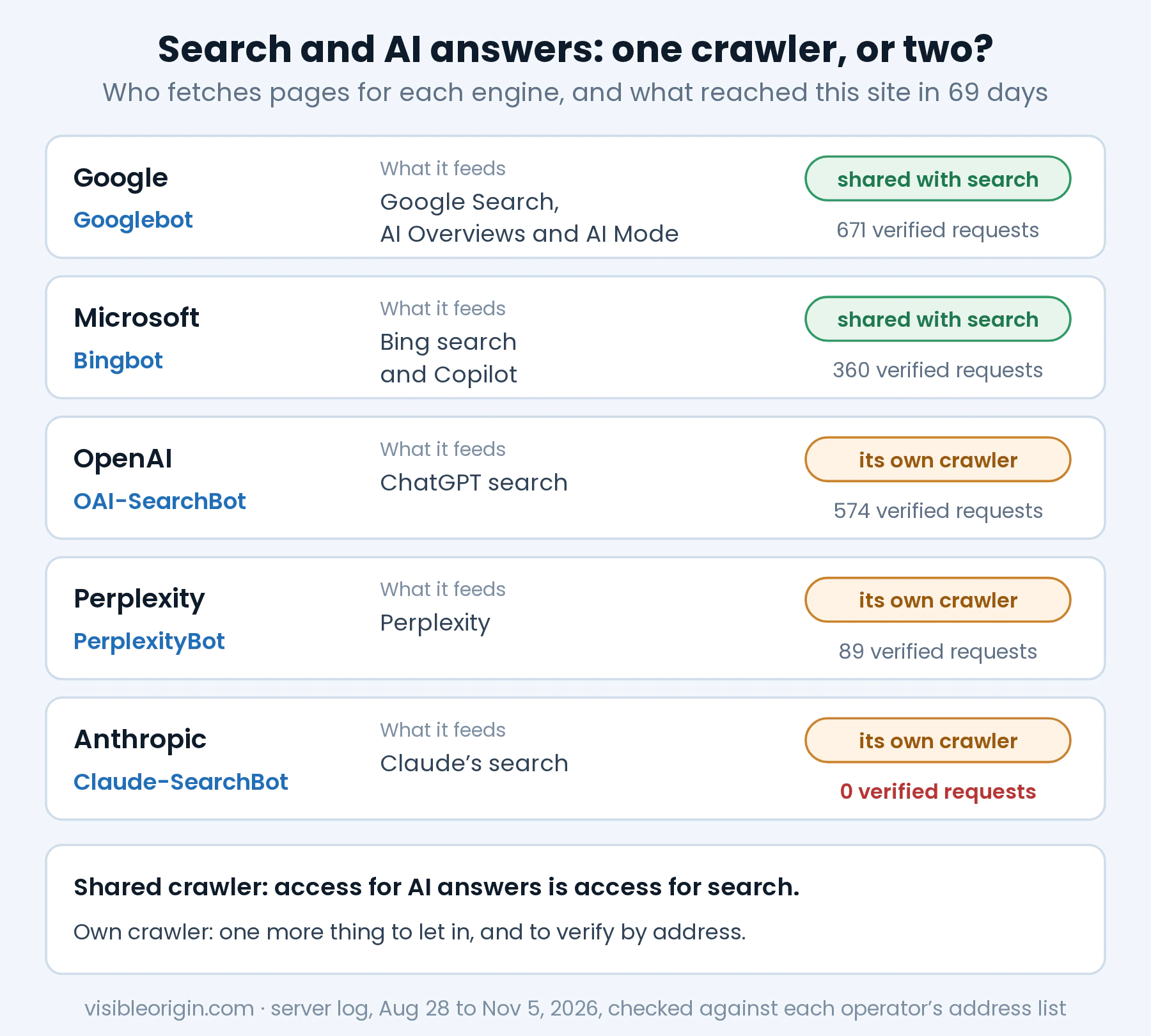
So I counted how much of this site each of those crawlers has actually fetched, next to Googlebot and Bingbot. The window is my server’s log from August 28 at 19:43 UTC to November 5 at 14:17 UTC, 69 days. A request counts only when it comes from an address on the list its operator publishes, downloaded on November 2 and again on November 5, which is the method from verifying AI crawlers by IP instead of by name. A page counts as fetched when the crawler got a 200 for it at least once. The sitemap lists 54 URLs.
| Crawler, and the answers it feeds | Verified requests | Sitemap URLs fetched |
|---|---|---|
| Googlebot: Google Search, AI Overviews, AI Mode | 671 | 48 of 54 |
| OAI-SearchBot: ChatGPT search | 574 | 43 of 54 |
| Bingbot: Bing and Copilot | 360 | 36 of 54 |
| PerplexityBot: Perplexity | 89 | 10 of 54 |
| Claude-SearchBot: Claude’s search | 0 | 0 of 54 |
This server’s access log, August 28 to November 5, 2026, counting only requests from addresses on each operator’s published list. None of them got a 401, 403, 429 or 5xx. Another 47 requests used the Claude-SearchBot name from addresses that are not on Anthropic’s list. Counts are floors: Cloudflare answers part of the traffic from its cache.
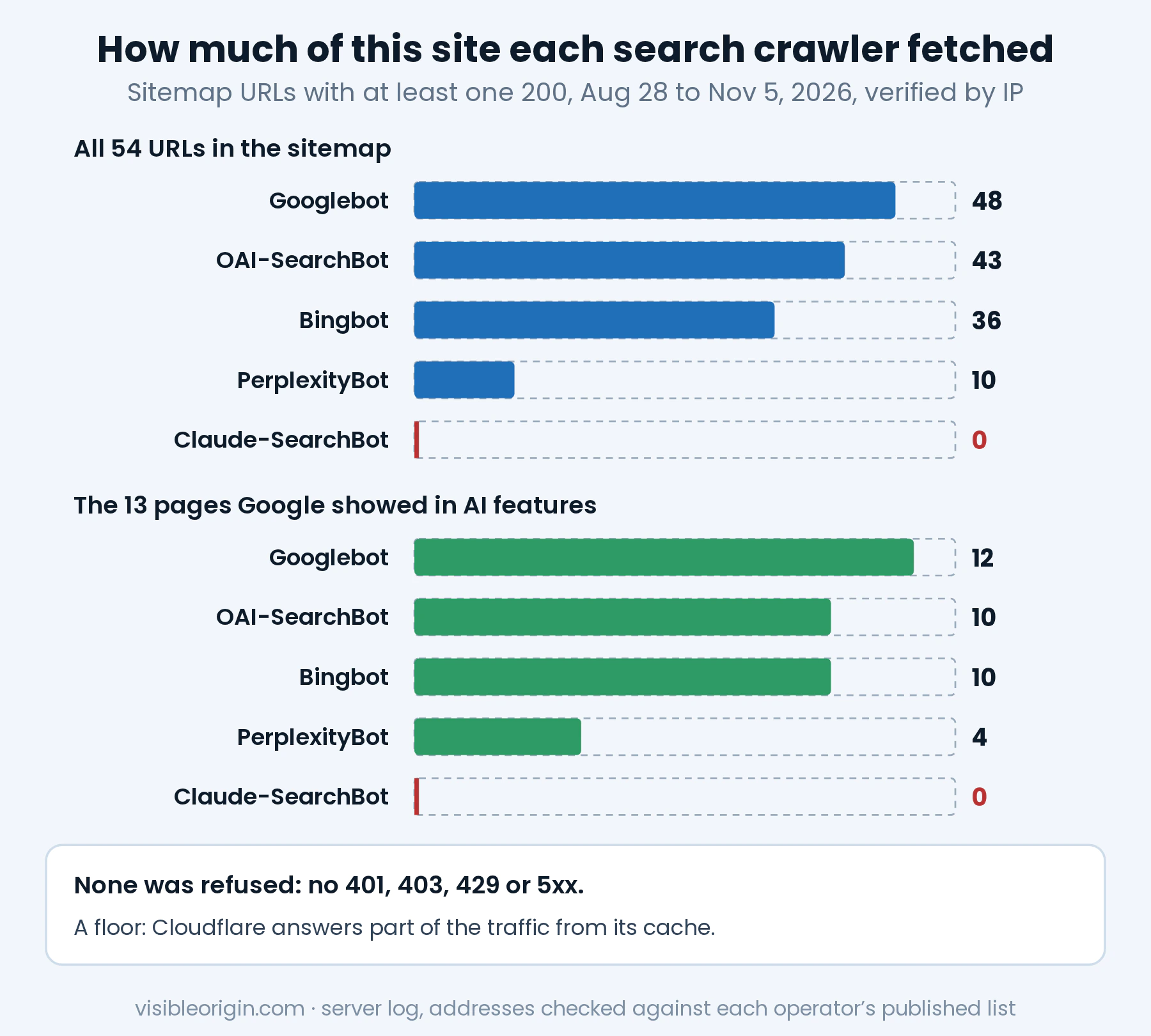
Three things stand out. First, none of these crawlers was refused anything: not one verified request got a 401, 403, 429 or 5xx, and my robots.txt lets all of them in, a choice I explain in robots.txt for AI crawlers, agent by agent. Second, coverage still varies widely between engines that all say they want to be let in. OAI-SearchBot fetched 43 of the 54 URLs and PerplexityBot 10, while Claude-SearchBot never reached my server from Anthropic’s addresses, although 47 requests used its name from other ones. Third, the overlap with Google’s AI features is partial. Of the 13 pages that Google showed in AI features, by November 5 Googlebot had fetched 12 from my server, OAI-SearchBot 10, Bingbot 10, PerplexityBot 4 and Claude-SearchBot none.
These counts are floors. Cloudflare answers part of the traffic from its cache, and a request answered at the edge never reaches my log, a limit I measured in what the access log cannot see. My note on 403 errors shows how wide that gap can be: Google has it indexed and showed it four times in AI features, yet no verified Googlebot request for it ever reached my server. A zero here is a zero at my server, not proof that a crawler never saw a page. Claude-SearchBot’s zero is the hardest one to explain away, because it covers every URL for 69 days.
For Bing, the gap is in the index rather than in the crawl. Bing’s Webmaster API counted 23 pages of this site in its index on November 2. Google’s URL Inspection API reported 48 of my 50 posts and pages as indexed on November 5. If Copilot rests on Bing’s index, as Bing says it does, then my bottleneck for Copilot is ordinary SEO work on Bing, which I measured step by step in submit your site to the Bing index.
And one of the two pages that Google has not indexed is my own Services page. Google’s inspection lists it as “Discovered – currently not indexed” with no crawl date, and no verified Googlebot request for it reached my server in the 69 days. A page outside the index cannot be a supporting link in AI Overviews, so this is an AEO problem with an SEO cause, on the very page that sells AEO. I publish it because it is the clearest example in my own data of where the work actually sits.
The part of AEO that a search-only check misses is whether each AI company’s crawler gets the page, through the CDN and the firewall, under its own name and from its own addresses. Testing that from outside, crawler by crawler, is what my crawler and AI readiness audit does. On my own site no crawler was refused, and the coverage gap above was there anyway. Being let in is a condition, not a guarantee that a crawler comes.
The AEO tactics in the guides, checked against the engines
The guides that rank for this question share a list of tactics. Here is each one next to what the engines document and what this site’s data shows.
| What the guides recommend | What the engines document | What this site shows |
|---|---|---|
| FAQ sections with FAQPage schema | Google: FAQ rich results only for “well-known, authoritative government and health websites” since 2023; “no special schema.org markup” for AI features | On all 40 notes; 11 of 33 notes with web impressions appeared in AI features, and so did two pages without an FAQ |
| A short, direct answer at the top | Google: “You don’t need to write in a specific way just for generative AI search.” | On all 40 notes, with the same 11 of 33 |
| Question headings and long-tail phrasing | Google: no need to worry about having enough “long-tail” keywords | Not measured on its own: every FAQ here uses question headings |
| llms.txt and other AI files | Google: no “new machine readable files, AI text files, markup, or Markdown” needed | No verified AI crawler asked for this site’s llms.txt in 66 days |
| Allow the AI crawlers | OpenAI, Anthropic, Perplexity: their search crawler is the way into their results | All allowed; 43, 10 and 0 of 54 URLs fetched |
| Track citations, not rankings | Google reports AI impressions; Bing’s AI Performance reports Copilot citations, from a sample | Google: 43 impressions in 38 days; Bing: no data for this site when last read, on October 20 |
Guides: the first three Google results for “aeo vs seo,” read on November 5, 2026. Engines: Google Search Central, Search Console Help and Bing Webmaster Guidelines, read the same day. Site: Search Console exports for September 24 to October 31 and the server log for August 28 to November 5.
Two rows deserve a sentence each. FAQ markup is the tactic all three guides recommend, and the one Google has narrowed the most. Google limited FAQ rich results in August 2023 to “well-known, authoritative government and health websites,” and its AI guide files structured data under the things not to overfocus on, while adding that it still helps “with being eligible for rich results on Google Search.” My notes carry FAQPage anyway, for agents that parse it, but nothing in the data above suggests it got any page into an AI Overview.
The other is llms.txt. Google says Search ignores it, and on this site no AI crawler verified by address asked for the file in 66 days, which I measured in does llms.txt work. The tactic in the list that does have an engine behind it is the plainest one: let each AI company’s search crawler in, and then check that it actually comes.
How to compare AEO and SEO on your own site
Everything above can be repeated on any site with Search Console and an access log. These are the four checks behind this note, in the order I would run them again.
1. Put your two Google reports side by side
In Search Console, export the performance report for web search and the generative AI performance report for the same dates. Each export contains a file of pages, called Pages.csv in an English interface. This prints, for every page that appeared in AI features, its AI impressions, its web impressions outside AI features, and its address:
python3 - web/Pages.csv ai/Pages.csv <<'EOF'
import csv, sys
web = {r[0]: int(r[2]) for r in list(csv.reader(open(sys.argv[1], encoding='utf-8-sig')))[1:]}
ai = {r[0]: int(r[1]) for r in list(csv.reader(open(sys.argv[2], encoding='utf-8-sig')))[1:]}
for url, n in sorted(ai.items(), key=lambda kv: -kv[1]):
    print(n, web.get(url, 0) - n, url)
EOF
If the pages at the top of your AI list are also near the top of your web list, your AEO and your SEO are the same project, as they were here. If a page with many web impressions never shows up in AI features, look at the queries it ranks for before you rewrite it: the AI export has no queries, so that comparison has to come from the web report. And if the generative AI report does not appear at all, Google says that “usually happens when your site hasn’t received enough impressions in generative AI features on Google Search.”
2. Count the AI crawlers by address, not by name
Download the published address list of the crawler you care about, and count the requests in your access log that use its name and come from a listed address. Here it is with OpenAI’s search crawler; Anthropic, Perplexity, Google and Bing publish equivalent lists:
curl -s https://openai.com/searchbot.json -o searchbot.json
python3 - searchbot.json access.log <<'EOF'
import ipaddress, re, sys
nets = [ipaddress.ip_network(c) for c in re.findall(r'[0-9a-fA-F:.]+/\d+', open(sys.argv[1]).read())]
ok = other = 0
for line in open(sys.argv[2], errors='replace'):
    if 'OAI-SearchBot' not in line:
        continue
    try:
        ip = ipaddress.ip_address(line.split()[0].strip('"'))
    except ValueError:
        continue
    if any(ip in n for n in nets if n.version == ip.version):
        ok += 1
    else:
        other += 1
print('verified:', ok, '| same name, other address:', other)
EOF
On this site’s log for the 69 days, it prints 574 verified requests, the count in the table above, and 106 with the same name from other addresses. A large second number is normal, since anyone can borrow a crawler’s name. If the verified count is zero for an engine that matters to you, check robots.txt and your CDN before anything else. The free AI visibility checker reads what your robots.txt allows each AI bot, and a CDN can refuse a crawler at the edge without touching that file, as I found when I compared what Cloudflare’s AI settings stop and what they only ask.
3. Read the indexes the answers draw on
Google’s URL Inspection, in Search Console or through its API, says whether a page is indexed and when it was last crawled, and Bing Webmaster Tools says how many of your pages Bing has. A page that is missing from Google’s index is not eligible for its AI features, and Bing ties Copilot to the same foundation as its search. The fix for a missing page is ordinary SEO: internal links to it, a sitemap that lists it, and, for Bing, IndexNow, which Bing’s guidelines list among its discovery signals.
4. Read the two citation reports, and write down the date
Search Console’s generative AI report and Bing’s AI Performance are the two first-party counts of AI visibility that the engines offer; the crawler pages of OpenAI, Anthropic and Perplexity that I read mention no report of their own. Write down the date each time you read them. On a young site both can stay nearly empty for weeks, and Bing warns that “very sparse or infrequent citations may not surface in the dashboard. This is expected and does not indicate a penalty or exclusion.”
AEO vs SEO: frequently asked questions
What is AEO?
AEO stands for answer engine optimization: work aimed at having a page used as the source of an answer, rather than listed as a result. The term was in use by February 2018, when the answers came from featured snippets and voice assistants. Today it usually means AI answers, such as Google’s AI Overviews, ChatGPT search or Perplexity. No standard defines it, and Google files it under SEO.
What is the difference between AEO and SEO?
For Google and Bing, the crawling, the index and the ranking are shared, and what differs is where a page shows up and how it is counted: Google includes AI Overview and AI Mode impressions in its web search data. For ChatGPT, Claude and Perplexity, AEO adds one job that SEO does not cover: letting each company’s own search crawler fetch your pages, and checking by address that it does.
Is GEO the same as local SEO?
No. In AI search, GEO means generative engine optimization, a name that comes from a 2023 research paper. In local and international SEO, “geo” refers to geography: ranking for searchers in a particular place, which Google says depends mainly on relevance, distance and popularity. The two share three letters and nothing else.
Is AEO replacing SEO?
Not according to Google, which says optimizing for its AI features “is optimizing for the search experience, and thus still SEO,” and not on this site’s numbers. Here, Google’s AI features accounted for 43 of 637 search impressions over 38 days, and they went mostly to pages that were already drawing impressions in ordinary results.
Do I need FAQ schema or llms.txt to appear in AI answers?
Not for Google, which says structured data “isn’t required for generative AI search” and that you do not need AI text files. Every note on this site has an FAQ section with FAQPage markup, and that did not separate the pages that appeared in Google’s AI features from those that did not. No AI crawler verified by address requested this site’s llms.txt in 66 days.
What is the difference between AEO and GEO?
Mostly their history. AEO dates from the voice-search years, around 2018; GEO was named in a 2023 paper and is the word Bing uses in its guidelines. Both describe the same aim, being a source that an AI answer draws on, and Google treats both as SEO. Neither name changes what a site can measure or control.
AEO vs SEO vs GEO: the verdict
Three names, one aim and, for the two engines that publish their position, one foundation. Google says its AI features are still SEO and counts their impressions inside web search. Bing says Copilot rests on the same crawling, indexing and ranking as its search. On this site, the pages that appeared in Google’s AI features were mostly the pages already visible in its results, and the answer-box-and-FAQ format that every note shares made no visible difference. The real differences are narrower than the guides suggest: three AI companies send search crawlers of their own, which covered very different parts of this site even though none was refused, and the reports count AI impressions and citations instead of rankings.
If you are deciding where to put limited time, the data suggests this order: get your pages indexed and visible in ordinary search, let each AI company’s search crawler in and verify by address that it comes, and then read the two reports that count AI impressions and citations, with the date. What nobody can sell you is the step after that, which happens inside the engines. Both commands above ran on this site’s own files and reproduce the figures they gave for this note; on your files, they give you the same two measurements of your own site.
Sources
- Google Search Central, Optimizing your website for generative AI features on Google Search (last updated July 10, 2026): the box on “AEO” and “GEO,” “thus still SEO,” the list of tactics to ignore, structured data and rewriting for AI.
- Google Search Central, SEO Starter Guide: the definition of SEO.
- Google Search Central, AI features and your website: a page must be indexed and eligible for a snippet, with no additional requirements.
- Search Console Help, Generative AI performance report (Search): the rollout date, the definition of an impression, the data taken from the Web search type, sites excluded from generative AI features, and the missing-report explanation.
- Search Console Help, What are impressions, position, and clicks?: how clicks, impressions and position are counted for AI Overviews.
- Google for Developers, Google’s common crawlers: what Google-Extended controls, and that it does not affect Google Search.
- Google Search Central Blog, Changes to HowTo and FAQ rich results (August 2023): FAQ rich results limited to well-known government and health websites.
- Google Business Profile Help, Understand factors that determine local ranking: relevance, distance and popularity.
- Aggarwal et al., GEO: Generative Engine Optimization, arXiv:2311.09735, first posted November 16, 2023, accepted to KDD 2024.
- Bing Webmaster Guidelines: the definitions of SEO and GEO, the shared foundation of Bing and Copilot, and the advice on grounding.
- Bing Webmaster Tools Help, AI Performance in Bing Webmaster Tools: citations are sampled, and sparse activity may not surface.
- OpenAI, Overview of OpenAI crawlers: OAI-SearchBot and ChatGPT search, and the published address list.
- Anthropic, Does Anthropic crawl data from the web: Claude-SearchBot and what disabling it does.
- Perplexity, Perplexity crawlers: PerplexityBot and its published address list.
- Search Engine Watch, The rise of Answer Engine Optimization: Why voice search matters (February 7, 2018): the earliest use of the term I could open, also in an archived copy from March 13, 2018.
- Kalicube, Answer Engine Optimization: the company’s own claim that Jason Barnard coined the term in 2017.
- My own measurements, November 5, 2026: Search Console exports for this site (web search and generative AI features, September 24 to October 31), WordPress revisions of the 40 notes, the server’s access log from August 28 to November 5 checked against each operator’s published address list, Google’s URL Inspection API and Bing’s Webmaster API.